
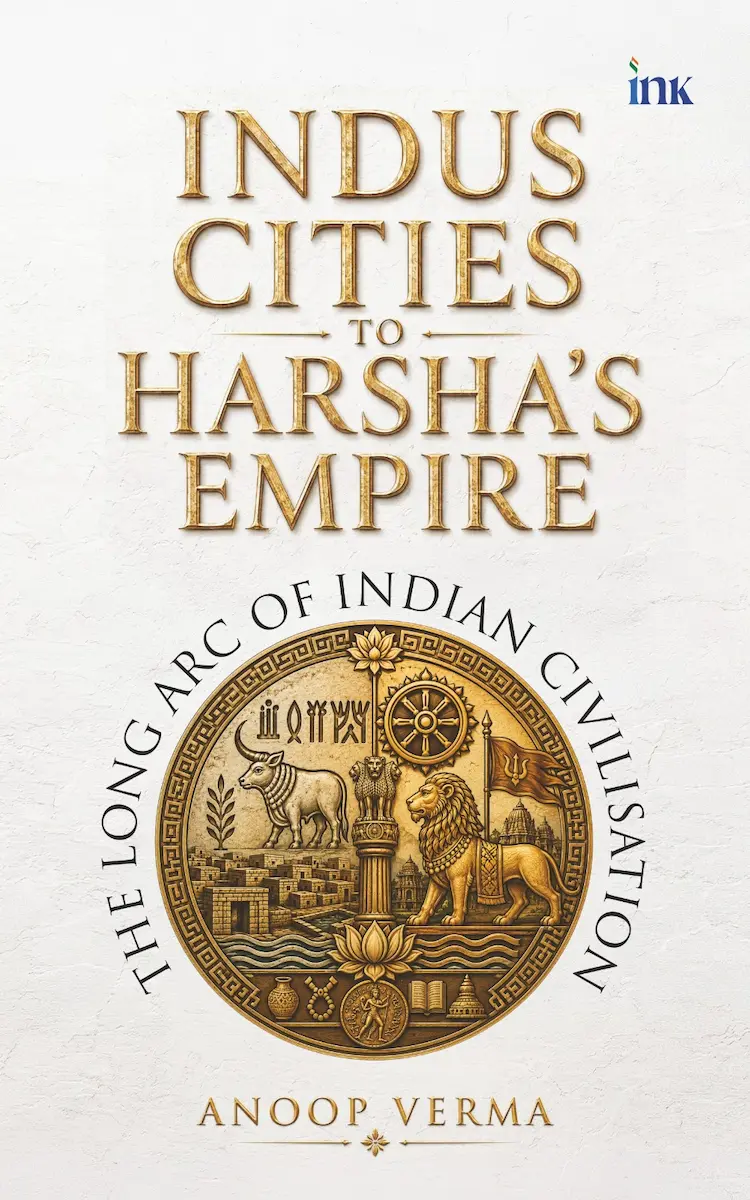

Description
Indus Cities to Harsha’s Empire presents a sweeping yet analytically rigorous account of the formation and evolution of ancient India. Tracing the interplay of material life, political power, and intellectual traditions across centuries, the book explores how one of the world’s most enduring civilisations continuously reimagined the relationship between society, authority, and the sacred.
The urban world of the Indus Valley, with its planned cities, standardised weights, and intricate seal systems, reveals a sophisticated grammar of order, exchange, and authority. From this material foundation emerges the Vedic age, where the centre of civilisation shifts from the city to scripture and the Vedas articulate a cosmology grounded in ṛta, dharma, and sacred knowledge. As ritual traditions deepen into philosophical inquiry, the
Upanishads probe the nature of the self and reality, while the epics and Puranas transform ethical conflict, kingship, and cosmic order into enduring civilisational ideals.
These intellectual and spiritual currents expand further through heterodox movements such as Buddhism, which redefine the relationship between self, society, and transcendence while carrying Indian thought across Asia. At the same time, new forms of political organisation reshape the subcontinent. Under the Mauryas, imperial power acquires unprecedented scale through the statecraft of the Arthashastra and Ashoka’s ethical vision of governance, recasting the relationship between authority and morality.
The Gupta age brings together many of these earlier currents in a period of cultural and intellectual synthesis marked by advances in science, literature, and political thought, even as emerging regional powers begin to transform the political landscape. In the post-Gupta world and the reign of Harsha, a fragmented yet culturally cohesive order takes shape, sustained by networks of religion, learning, and exchange. Across this longue durée, the book argues, Indian civilisation evolved not as a fixed tradition but as a dynamic process shaped by the continuous interaction of material structures, philosophical inquiry, and political imagination.
Publisher : Bluone Ink ; Author : Anoop Verma ; Pages: 528; Paperback


Reviews
There are no reviews yet.